How to Write a Wedding Order of Service: What to Include, Wording and Examples
Everything that goes into a wedding order of service, page by page, with church and civil templates, wording you can copy and the checks to make before anything goes to print.
In short: a wedding order of service is the printed guide your guests hold during the ceremony. It runs through each part in order, gives the hymn words and reading titles, names the wedding party and usually ends with a thank you and the reception details. Print one per household plus about ten spares, finalise the wording once your vicar, registrar or celebrant has approved your readings and music, and send it to print three to four weeks before the day.
What is a wedding order of service?
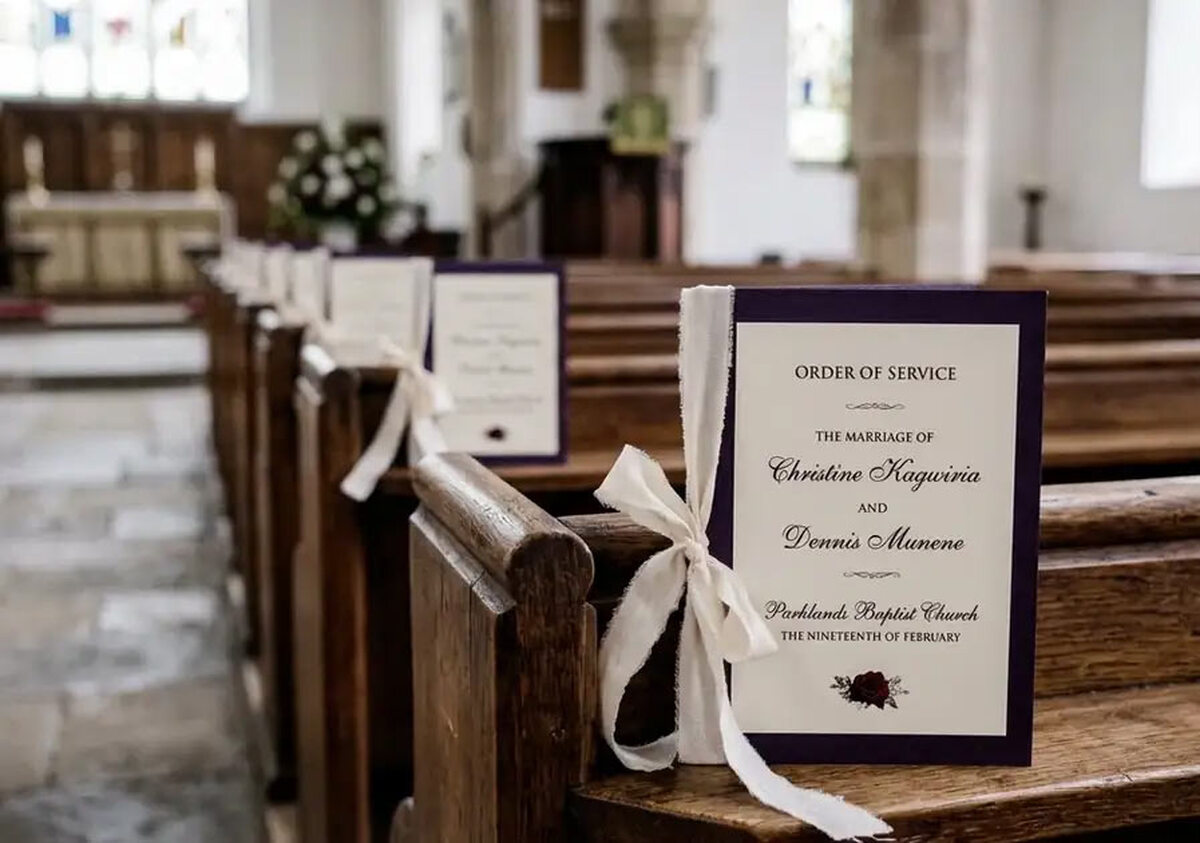
A wedding order of service is a card or booklet that takes guests through your ceremony, from the first piece of music to the last. It tells them what’s happening, who’s reading, which hymn comes next and when to stand. Without one, guests mumble through hymns they half remember and spend the readings wondering who the woman at the lectern is.
It does a quieter job, too. It names the people who matter to you, from your parents to the friend playing the guitar, and it’s often the one piece of wedding stationery guests take home. Plenty end up on a mantelpiece, in a memory box or between the pages of a favourite book.
The name can change with the ceremony. “Order of service” is the traditional term and sits naturally with a church wedding. A lot of couples marrying in a civil ceremony call it an “order of ceremony” instead, because “service” sounds religious. Either is fine. Don’t confuse either with an order of the day, which is the timeline for the whole wedding, from the drinks reception to the last dance, rather than the ceremony alone.
Do you need an order of service?
No. Nothing in law says you need one, so it comes down to what‘s in your ceremony.
-
Church weddings: almost always worth it. There’s a lot to follow, from hymns and spoken responses to the Bible reading every Church of England wedding must include, and guests need the words in front of them.
-
Civil ceremonies: optional. With readings and music to credit, an order of service helps guests follow along. For a short, simple ceremony, a sign at the entrance does the same job.
-
Celebrant-led ceremonies: often the most personal of all, with rituals and readings guests may not have seen before, so a line or two explaining each one helps everyone feel part of it.
If you’re still choosing between a church, civil or celebrant-led ceremony, Wed’s guide to ceremonies explains how each one works.
Some couples skip printing altogether and share the running order on their wedding website or through a QR code on a sign. It saves paper, but it means guests have their phones out during the ceremony, which sits awkwardly if you’ve asked for an unplugged wedding. If you‘d like a low-waste option, one large board at the entrance works better, and it doubles as a keepsake afterwards.
What to include in a wedding order of service
Most orders of service follow the same layout: a cover, the running order inside, a page for the wedding party and a back page for thank yous and practical details. A single card fits the essentials onto two sides, while a booklet gives you room for full hymn words, a wedding party page and a photo or two.
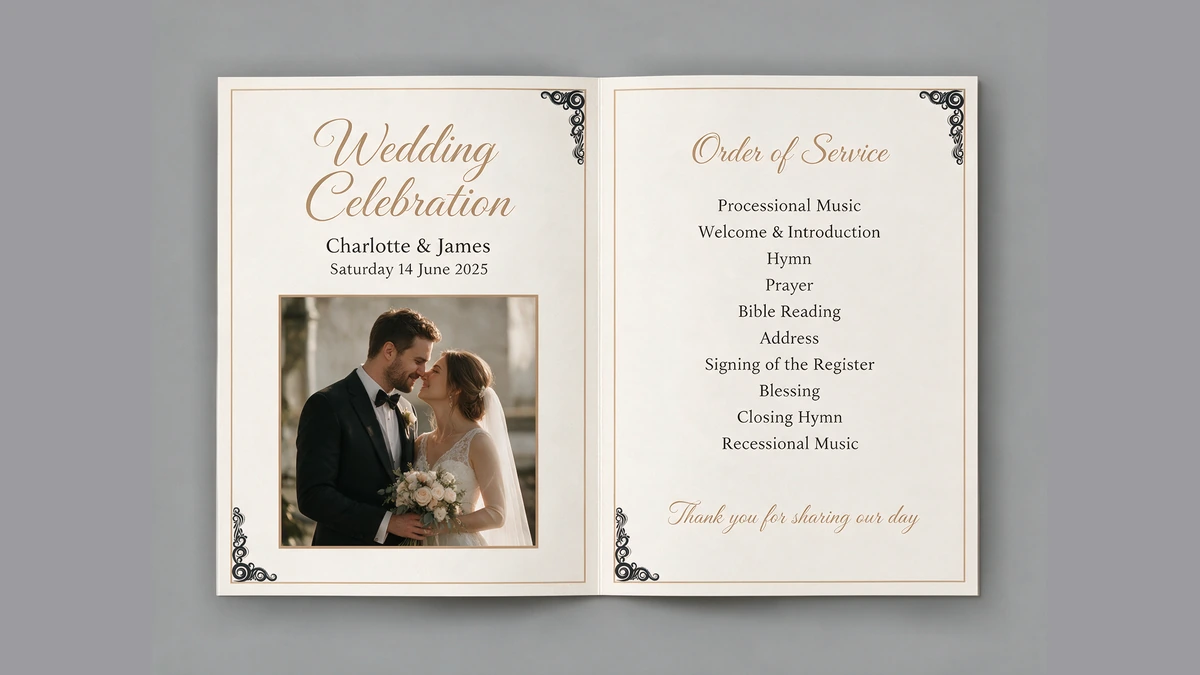
The front cover
-
Your names. Traditionally the bride’s name comes first, but use whichever order you like. Plenty of couples simply go alphabetical.
-
The date, and the time if you like.
-
The venue: the church name and town, or the venue and county.
-
A title, such as “Order of Service”, “Order of Ceremony” or simply “Our Wedding”.
-
**Something that ties it to your invitations:** a monogram, a line drawing of the church or venue, your wedding colours or a favourite photo of the two of you.
The inside pages
This is the running order: every part of the ceremony in sequence, with whatever guests need at each point.
-
Music: the title and composer or artist for your entrance, the signing and your exit.
-
Hymns: the title, and the words in full for every verse you‘ll sing. Only print a hymn number on its own if the church is handing out hymn books.
-
Readings: the title, the author and the reader’s name, with a few words on who they are, such as “read by Sophie, sister of the bride”. If you haven’t picked yet, Wed’s advice on choosing your readings is a good place to start.
-
Cues: short instructions in italics, such as “please stand as the bride enters” or “please be seated”, so nobody has to guess.
-
The officiant: the name of your vicar, registrar or celebrant.
The wedding party
A who’s who page saves a lot of whispering in the pews. Include your parents, the best man, the maid or matron of honour, bridesmaids, ushers, page boys and flower girls, readers, musicians and whoever‘s leading the ceremony. Some couples add a line about each person, such as “best friends since our first week at university”, which gives guests something to chat about over drinks.
The back page
-
A thank you to your guests, and to everyone who helped make the day happen.
-
A remembrance line for loved ones who can’t be there.
-
Reception details: the venue, address and start time, plus parking or transport notes if you’re moving on somewhere else.
-
Requests: an unplugged ceremony note, or where and when to throw confetti. Lots of venues only allow natural petal confetti and some churches ban it entirely, so check before you print.
-
Extras: your wedding hashtag, or a QR code for a shared photo album guests can add to after the day.
How long should it be?
Shorter than you‘d think. A civil ceremony without hymns fits comfortably on a single card. One or two hymns need a folded card with four pages. A full church service with three hymns, readings and prayers usually runs to a booklet of eight pages or more. If something has to go, keep the hymn words and the running order and cut the extras first.
Church of England order of service template
Church of England weddings follow the marriage service in Common Worship, which sets the structure and most of the words. Your vicar will confirm the running order and may move a few parts, so treat this as a draft to take to your wedding meeting. Copy it and swap the square brackets for your own details.
The entrance of the bride: [music, composer]
The welcome: [vicar’s name]
Hymn: [title], with the words in full
The preface: the vicar introduces the meaning of marriage
The declarations: you each answer “I will”, then the congregation is asked whether they will support you and answers “We will”
The collect: a short prayer
Reading: [title and Bible reference], read by [name]
The sermon: [vicar’s name]
The vows
The giving of rings
The proclamation: the vicar declares you married
The blessing of the marriage
The registration: [music, or a hymn with the words in full]
Prayers, ending with the Lord’s Prayer
Hymn: [title], with the words in full
The dismissal and blessing
The exit: [music, composer]
A few parts can move. The readings and sermon can come before the vows or after the blessing of the marriage, and the registration can happen straight after the marriage or at the very end of the service, so check with your vicar before you lay out the pages. Print “We will” in bold under the declarations so guests know to answer, and print the words of the Lord’s Prayer in full if a lot of your guests don’t often go to church.
Catholic and other religious ceremonies
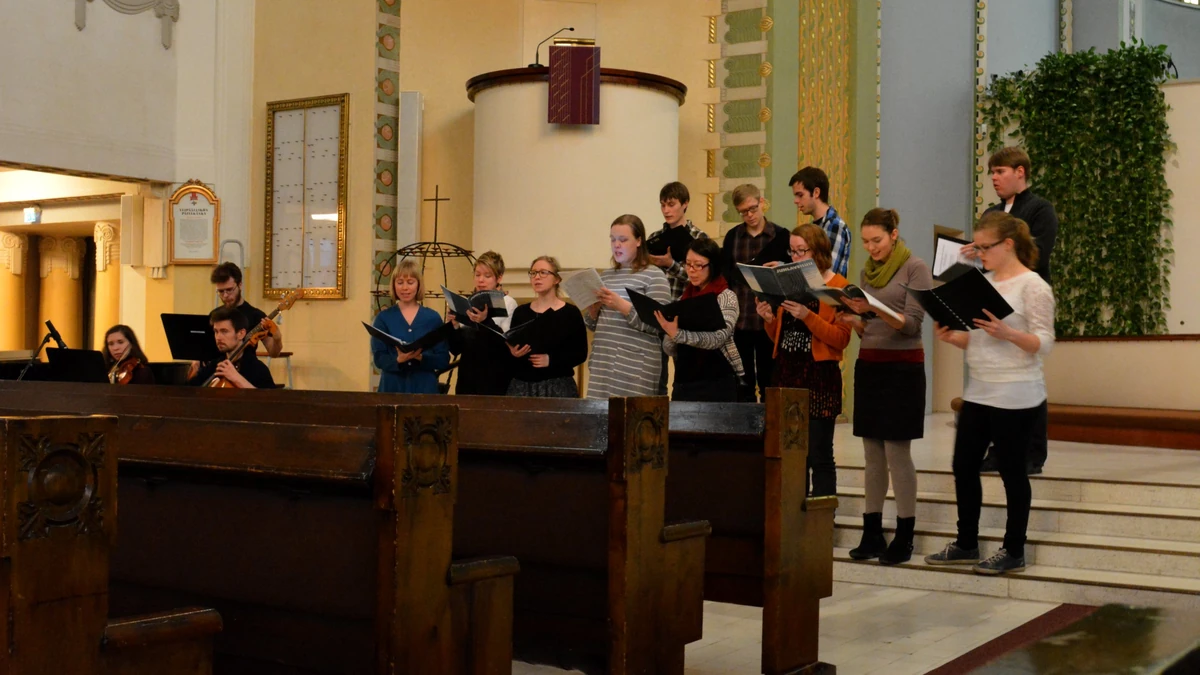
A Catholic wedding can take place within a Nuptial Mass or in a shorter ceremony without Mass. A Mass adds Holy Communion, so the order of service runs longer, and printing the congregation’s responses helps guests who aren’t Catholic join in. A short, kind note on who can receive Communion saves guests from guessing, and your priest can suggest the wording. Your priest will also give you the running order.
Other faiths have their own sequences and rituals: the breaking of the glass at a Jewish wedding, the four laavan at a Sikh Anand Karaj, the seven steps of the saptapadi at a Hindu wedding. A sentence on what each ritual means lets guests who‘ve never been to one follow what’s happening, and it gives them something to read again afterwards. Ask your officiant to check those lines, because practice varies from one community to the next.
A blessing after a civil ceremony
If you’ve married at a register office and are having a church blessing afterwards, the Church of England has a separate service for it, called An Order for Prayer and Dedication after a Civil Marriage. You’re already legally married, so there are no legal declarations and no registration to print. The upside is that this is where the hymns, prayers and Bible readings a civil ceremony can’t include belong.
Civil ceremony order of service template
A civil ceremony is led by a registrar, either at a register office or at a venue approved for weddings, such as a hotel, barn or country house. The legal part is short: you each say the declaratory and contracting words in front of at least two witnesses, choosing from a few approved versions your registrar will give you. Everything around that can be personalised, with one firm rule. Civil ceremonies can include readings, songs and music, but nothing religious, according to GOV.UK’s ceremony guidance: no hymns, and no readings from the Bible or the Torah.
The entrance: [music, composer or artist]
Welcome and introduction: [registrar’s name]
Reading: [title, author], read by [name]
The declaratory and contracting words: your legal vows
The exchange of rings
The pronouncement
Reading or music: [title, author or artist]
Signing of the schedule: [music]
The exit: [music, composer or artist]
Your registrar will ask to see your readings and music before the day. Send the full list, including song titles, and wait for approval before you print, because a lyric you’ve never thought twice about can still count as religious. A passing mention of God in an otherwise non-religious love song is often allowed, but a hymn or a prayer isn’t, and the decision rests with your registrar. Some registration services also build in set elements of their own. Cornwall Council’s Classic ceremony, for example, ends with a traditional Cornish reading, and your celebrant registrar provides the music for your entrance and exit, so ask for the titles if you’d like to print them.
Humanist and celebrant-led ceremonies
Humanist and independent celebrant ceremonies aren’t legally binding in England and Wales yet. The government consulted in the summer of 2026 on reforms that would let humanists conduct legally binding weddings, but until the law actually changes, couples marry legally with a registrar, usually in a short register office appointment, and hold their celebration separately. It’s a different picture in Scotland and Northern Ireland, where humanist weddings are already legal.
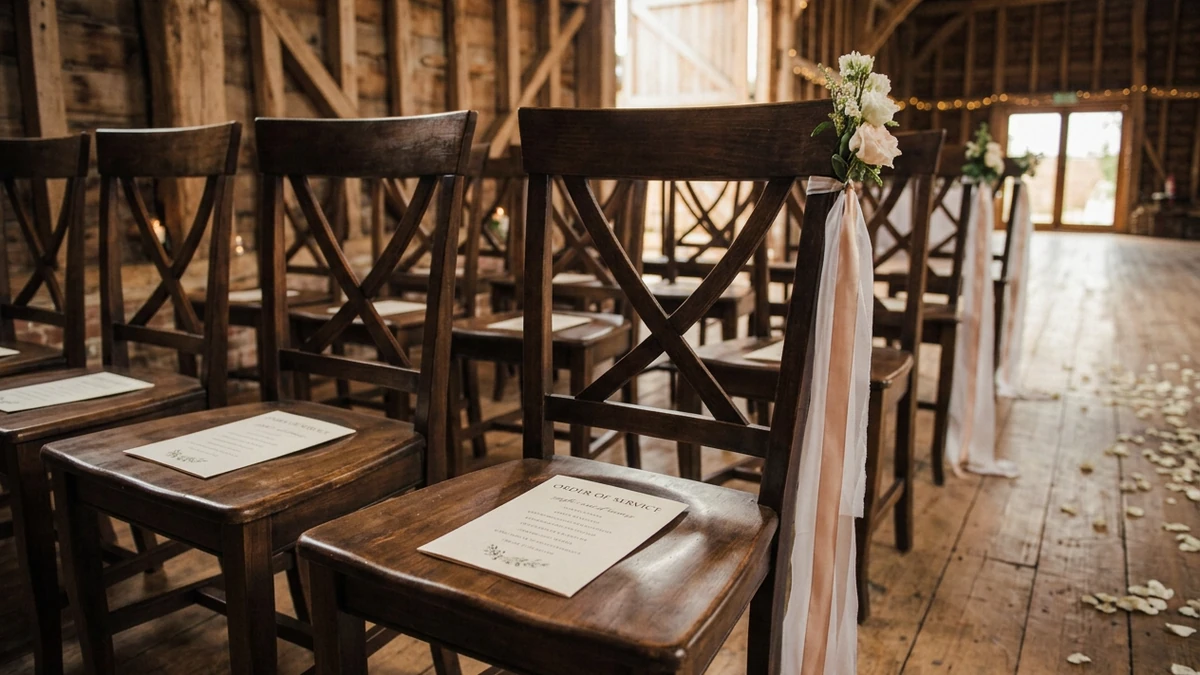
The upside is a much freer order of service. A celebrant-led ceremony isn’t bound by the civil rules on content, so it can include a handfasting, a ring warming, personal vows, the song from your first date, a hymn your nan loved or a reading from any source you like. Since the legal paperwork happens elsewhere, leave out the signing, or swap it for a moment of your own, such as signing a keepsake certificate in front of your guests.
Wedding order of service wording examples
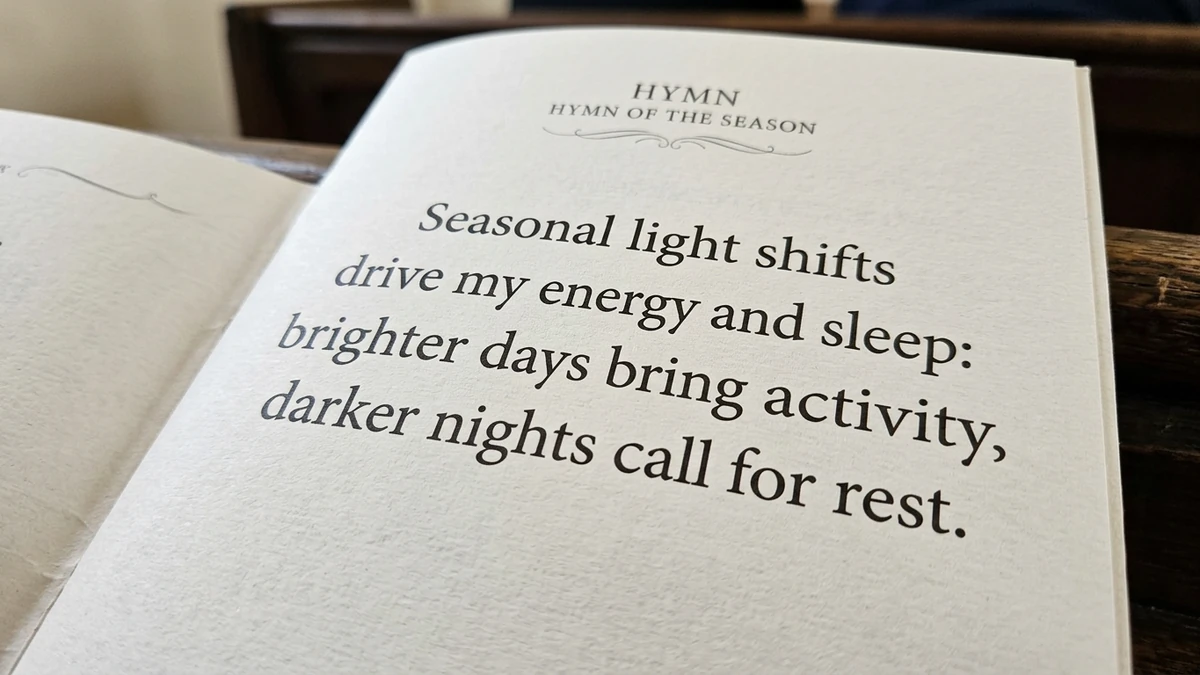
Use these as they are or adapt them. A slash marks a line break.
Cover wording
Traditional: “The Marriage of / [Full name] / and / [Full name] / [Church name], [Town] / Saturday 12 June 2027 at 2pm”
Modern: “[Name] and [Name] / are getting married / [Venue], [County] / 12.06.2027”
Civil: “Order of Ceremony / [Name] and [Name] / [Venue] / [Date]”
Welcome message
“Welcome, and thank you for being here as we begin our married life together. Today wouldn’t be the same without you.”
“We’re so glad you could join us. Please sit back, put your phones away and enjoy the ceremony with us.”
Running order lines
Keep each line short, with the part first and the details after it:
“The entrance of the bride: Canon in D, Johann Pachelbel”
“Reading: Sonnet 116, William Shakespeare, read by [name], friend of the groom”
“Hymn: Love Divine, All Loves Excelling (please stand)”
“Signing of the schedule: [song title], [artist]”
Thank you messages
“Thank you for sharing our day, for travelling so far and for all your love and support. We can’t wait to celebrate with you.”
“A special thank you to our parents, for everything that brought us here, and to everyone who helped make today happen.”
In memory lines
A line on the back page is one of the gentlest ways to remember loved ones who can’t be there, and it doesn’t ask anyone to stand up and speak on the day.
“Today we remember [names], who are with us in our hearts.”
“In loving memory of [name]. We know you would have loved today.”
Back page notes
“Please join us for drinks and the wedding breakfast at [venue], [town], from [time].”
“We’d love you to be fully present with us, so please keep phones and cameras away during the ceremony. Our photographer will capture every moment.”
“Petal confetti will be handed out after the ceremony. Please save your throwing for the church steps.”
How many orders of service do you need?
Count households, not guests. Couples and families usually share a copy, so you’ll need well under one per guest. For 100 guests, that’s often somewhere around 60 to 70 copies.
Then add spares for:
-
the vicar, registrar or celebrant
-
the organist, choir or musicians
-
your readers
-
the photographer and videographer
-
keepsakes for you and both sets of parents
-
guests who arrive empty-handed or leave theirs on the chair
Ten or so extras covers most weddings. If your service has several hymns, think about one copy per adult instead: two people can share a hymn sheet easily, but a family of four can’t.
Order of service sizes, formats and printing
The right format comes down to how much you need to fit in and where you’re marrying.
|
Format |
Typical size |
Best for |
Watch out for |
|---|---|---|---|
|
Single card |
A5 (148 x 210 mm) or DL (99 x 210 mm) |
Short civil ceremonies without hymns |
Little room for hymn words |
|
Folded card |
A4 folded to A5, giving four pages |
Most ceremonies with one or two hymns |
Long hymns can spill over |
|
Booklet |
A5, eight to twelve pages |
Church weddings with several hymns |
The page count must be a multiple of four |
|
Paddle fan |
A card shape on a wooden handle |
Summer and outdoor ceremonies |
Room for a short running order only |
|
Scroll |
A rolled sheet tied with ribbon |
Vintage and themed weddings |
Hard to hold open while singing |
|
Entrance board |
A1 or A2 sign on an easel |
Small and low-waste weddings |
Guests can’t follow hymns from it |
Single cards and booklet covers are usually printed on heavier card, with lighter paper inside a booklet so it folds flat. Each sheet folds into four pages, which is why a booklet’s page count, cover included, has to be a multiple of four. If you‘re left with a spare page, use it for a photo, the wedding party or a favourite quote.
For clifftop, beach and garden ceremonies, choose single cards or fans over booklets, which flap about in the wind, and hand them out at the entrance rather than leaving them on chairs. At a summer ceremony on the Cornish coast, guests will be glad of a fan.

Design tips
-
Match the order of service to your invitations, so everything looks like one set.
-
Save script fonts for your names and headings, and set hymn words and readings in a clear, simple font.
-
Use dark text on a light background. Pale grey or gold text looks lovely on screen and all but disappears in a dim church.
-
Leave white space around the running order. A crowded page is harder to follow than a longer one.
-
Finish with a ribbon, twine or a wax seal if it suits your style, but check a booklet still opens flat with it on.
-
Print a handful of large-print copies for older guests, and ask an usher to offer them at the door.
Making your own or using a stationer
There are three ways to get them made: through a stationer, at a local print shop, or on your own printer at home. If you’re doing it yourself, the free editor at WeddingTemplates.com lets you reword an order of service design and print it at home or at a local print shop. Print one copy first and check the size, the spelling and the page order in your hand before running the rest, and run a test sheet if you’re using heavy card, which some home printers won’t feed. If a stationer is designing yours, book early and ask how long proofs and printing take, because you’ll need your final wording well before the wedding.
When to finalise and print your order of service
Your order of service relies on decisions other people have to approve, so work back from the wedding date.
-
Three to four months before: draft the running order and share it with your vicar, registrar or celebrant.
-
Two to three months before: choose your readings, music and readers, and get them approved by your vicar or registrar.
-
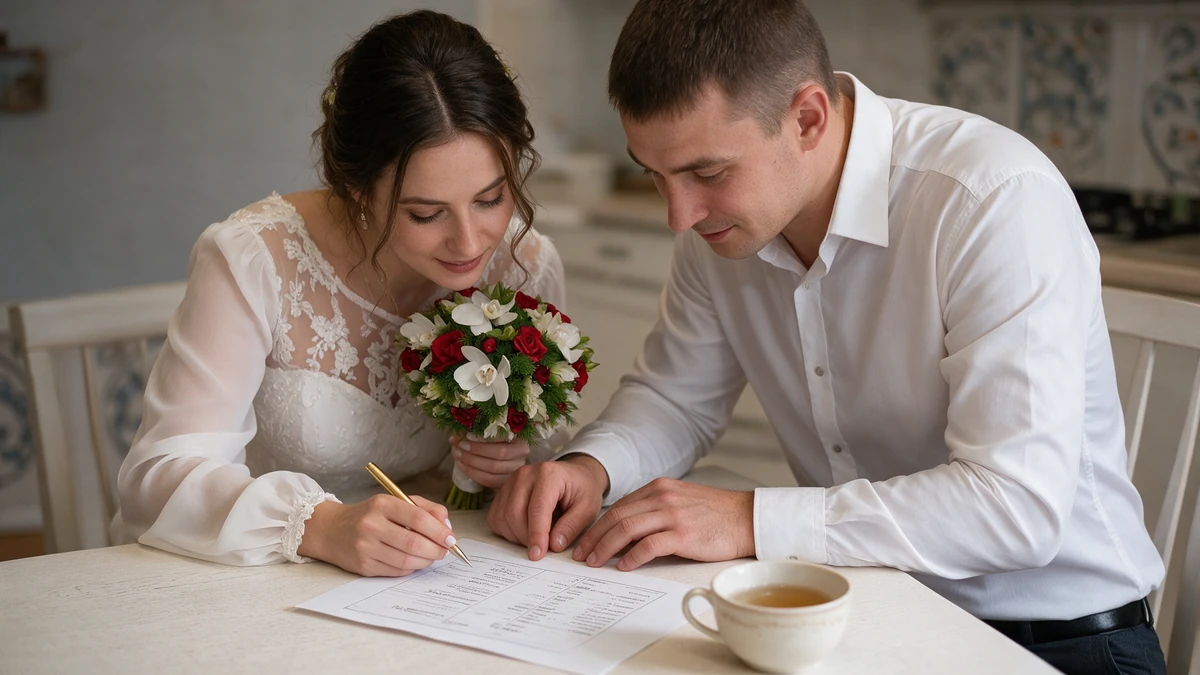
About six weeks before: finalise the wording. Check every name, the hymn verses and the reading titles, then ask someone who hasn’t seen it yet to proofread it out loud.
-
Three to four weeks before: print, or send the final files to your stationer, leaving time to reprint if anything goes wrong.
-
The week of the wedding: fold, tie and box them up, and label the box so the ushers can find it on the morning.
If something changes after printing, like a reader dropping out, you don’t need to reprint. Ask the officiant to mention it, or tuck a small printed slip inside each copy.
Who hands out the order of service?
At a church wedding, the ushers hand them out at the door as they show guests to their seats, keeping a few back for the vicar, organist and readers. It’s also a lovely job for a page boy or flower girl, as long as an adult stands with them and keeps the pile topped up.
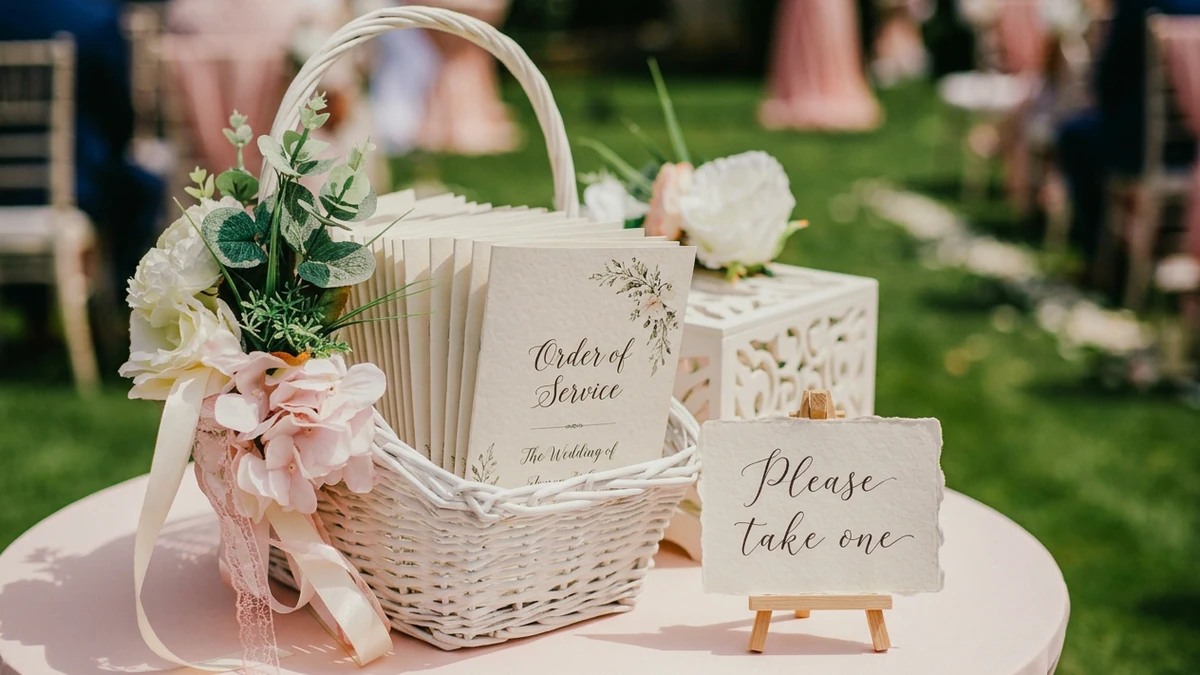
At a civil or outdoor ceremony, you can leave them on the chairs before guests arrive, but weigh them down or tie them on with ribbon if there’s any breeze at all. A basket at the entrance with a small sign works just as well.
Common order of service mistakes to avoid
-
Printing before approval. Wait until your vicar or registrar has confirmed your readings and music, or you may pay to print twice.
-
Religious content in a civil ceremony. Hymns and Bible readings can’t be part of a civil ceremony, so check song lyrics as well as readings, and send anything borderline to your registrar early.
-
Hymn words that don’t match the church’s hymn book. A lot of hymns exist in more than one version, so copy the words from the book your church actually uses, or half the congregation will be singing a different verse.
-
Forgetting copyright. Printing the words of a hymn or worship song usually needs permission, unless it’s old enough to be out of copyright, as many traditional hymns are. A lot of UK churches hold a Church Copyright Licence, which covers most hymns and songs, and CCLI, the organisation behind it, says the church is responsible for permissions even when the family designs and prints the order of service. Ask your vicar whether your choices are covered and how to word the credit, which usually sits under each hymn with the author, the publisher and the church’s licence number.
-
Misspelled names. Check every name with the person it belongs to, including readers, musicians and the officiant, and ask stepparents how they’d like to be listed.
-
Booklet pages that don’t add up. A booklet needs 4, 8, 12 or 16 pages.
-
Text that’s too small. Churches can be dim, and not every guest will remember their reading glasses, so keep hymn words large and well spaced.
-
An outdated heading. Since May 2021, couples in England and Wales sign a marriage schedule or marriage document rather than a register book. “Signing of the Register” is still printed and widely understood, but “Signing of the Schedule” or “The Registration” is the accurate heading.
Wedding order of service FAQs
Do you need an order of service for a civil ceremony?
No. An order of service is optional at any wedding. It’s most useful when you have readings or music to credit. For a short, simple ceremony, a single sign at the entrance does the same job.
What is the difference between an order of service and an order of the day?
An order of service covers the ceremony only. An order of the day covers the whole wedding, from the ceremony and drinks to the wedding breakfast, speeches and first dance, and usually goes on a sign at the reception or on the back page of the order of service.
Can you have a hymn at a civil wedding?
No. Civil ceremonies in England and Wales can’t include religious content, and that includes hymns. If faith matters to you, you can have a religious blessing after the civil ceremony, which is the place for hymns and prayers.
Should you print your vows in the order of service?
It’s up to you. The legal words in a civil ceremony are short and fixed, so plenty of couples leave them out. Some church couples print the traditional vows so guests can follow along, while couples who write their own wedding vows usually keep them as a surprise.
What size should an order of service be?
A5 is the usual size, as a single card, a folded card or a booklet. DL suits a slimmer single card, and A6 (105 x 148 mm) works for a short running order.
How far in advance should you print your order of service?
Three to four weeks before the wedding, once the wording is final. That leaves time to fix mistakes without paying for rushed printing.
The page your guests take home
An order of service is the one part of the ceremony guests can hold. Agree the running order with your vicar, registrar or celebrant, print the words people need, thank the people who made the day possible, and it‘ll do its job twice: once during the ceremony, and again years later when someone finds it in a drawer and remembers the day.